
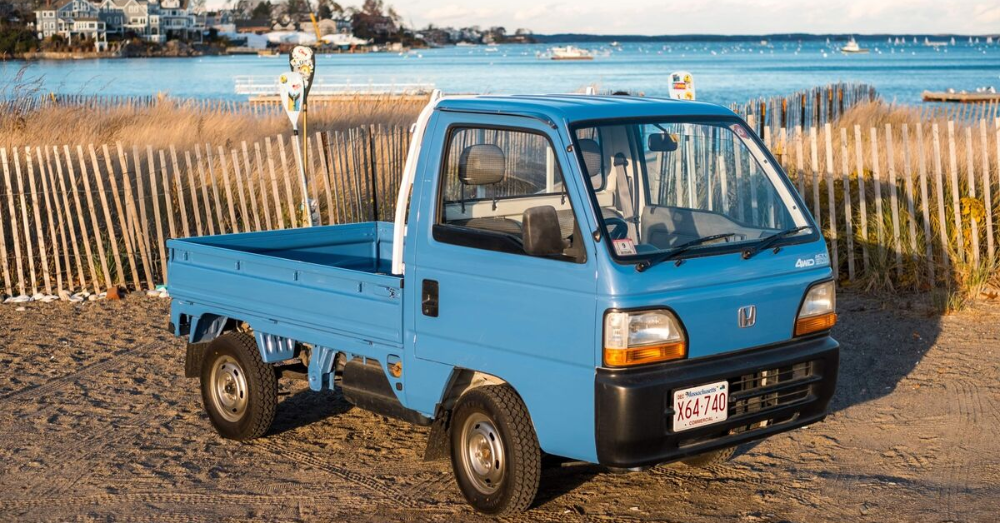
Drive through any rural town or scroll through your local classifieds lately? You’ve probably spotted them: tiny pickup trucks that look like they escaped from a toy store. These pint-sized haulers are Japanese kei trucks, and they’re building a serious following across America. What started as a trickle of imports has turned into a full-blown movement, with owners swearing these mini trucks can handle just about anything you throw at them.
- Kei truck imports to the U.S. jumped from under 2,000 units in 2018 to more than 7,500 in 2024, showing massive growth in popularity.
- The 25-year import rule now allows 1990s and early 2000s models into the country with fewer restrictions, making them accessible to American buyers.
- Legal battles are heating up across different states, with places like Texas and Colorado recently passing laws to allow kei trucks on roads while others maintain bans.
What Makes a Kei Truck Different
In Japan, these vehicles aren’t just small trucks. They’re part of a special vehicle class called “keijidōsha,” which translates to “light vehicle.” Japanese regulations cap these trucks at specific dimensions: no more than 11.2 feet long and 4.9 feet wide. Engine size? Limited to a tiny 660cc, roughly the size of what you’d find in a motorcycle.
Put that next to a full-size American pickup like a Chevrolet Silverado 1500, which stretches over 230 inches long and 80 inches wide, and you start to get the picture. Most kei trucks are about the size of a compact car, which makes them easier to squeeze into tight alleys, crowded driveways, and urban neighborhoods where parking a full-size truck feels like trying to parallel park a boat.
Why Americans Are Buying Them Now
The timing couldn’t be better for kei truck fever. First, there’s the 25-year import rule. Once a vehicle turns 25, it can legally enter the U.S. without jumping through as many regulatory hoops. Models from the late 1990s and early 2000s are now fair game, and importers are bringing them in by the thousands.
Then there’s the price tag. While a new Silverado High Country starts around $68,000 and a Ford F-150 Raptor pushes close to $80,000, you can grab a used kei truck for anywhere between $3,800 and $10,000. For small business owners, farmers, and hobby builders, that’s a huge difference. One landscaper in Pennsylvania bought his 1994 Subaru Sambar for about $10,000 and uses it for everything around his properties. Another owner in Texas picked up a 1998 Suzuki Carry for just $3,800.
Popular models include the Honda Acty, Suzuki Carry, Subaru Sambar, and Daihatsu Hijet. Each has its own quirks, but they all share the same DNA: simple mechanics, four-wheel drive options, manual transmissions, and fuel economy that puts bigger trucks to shame. Many owners report around 40 mpg, which is hard to beat.
The Legal Patchwork Problem
Here’s where things get messy. Federal law says kei trucks 25 years or older can be imported. But each state decides whether you can actually drive them on public roads.
Texas was one of the battleground states. After effectively banning kei trucks since 2010, advocacy groups like Lone Star Kei fought back. In April 2024, Texas reversed its ban, and by May 2025, lawmakers passed a bill officially recognizing “miniature vehicles” for titling and registration. Colorado followed suit with its own law, though it won’t take effect until 2027.
Other states aren’t playing ball. Georgia and Maine have moved to block kei truck registrations entirely, citing safety concerns. Massachusetts initially banned them, then reversed course after an uproar from owners. Currently, around 19 states allow kei trucks on public roads with various restrictions, while others limit them to private property or agricultural use.
Who’s Actually Using These Things
You’d be surprised. Small landscaping companies are scooping them up as yard trucks. Resort properties use them for maintenance runs. Construction crews appreciate the tight turning radius on job sites. Some owners have turned them into camping rigs or mobile food stalls.
The off-road crowd loves them too. With standard four-wheel drive and a bed that rivals crew cab versions of full-size trucks, they handle trails and rough terrain better than you’d expect from something that weighs about as much as a golf cart.
Making the Case for Going Tiny
Look, nobody’s claiming a kei truck will replace your towing rig or handle a cross-country furniture haul. But for local jobs, farm work, and property maintenance, they’re surprisingly capable. You burn less fuel, spend less money upfront, and can actually fit in normal parking spots.
As one Texas owner put it: his Suzuki Carry can do virtually everything a full-size pickup does for around-town work, but at a fraction of the price. That’s the pitch that’s winning people over, one tiny truck at a time.
Where This Movement Goes Next
The kei truck community keeps growing. Online groups like Kei Trucks Appreciation Society on Instagram have racked up over 95,000 followers who share builds, swap parts, tips, and advocate for changing restrictive state laws.
With advocacy groups scoring wins in states like Texas and Colorado, and more owners proving these little trucks can hold their own, the momentum seems to be shifting. Whether your state allows them or not, one thing’s obvious: Japanese kei trucks have found a permanent home in the American automotive landscape.
This post may contain affiliate links. Meaning a commission is given should you decide to make a purchase through these links, at no cost to you. All products shown are researched and tested to give an accurate review for you.