
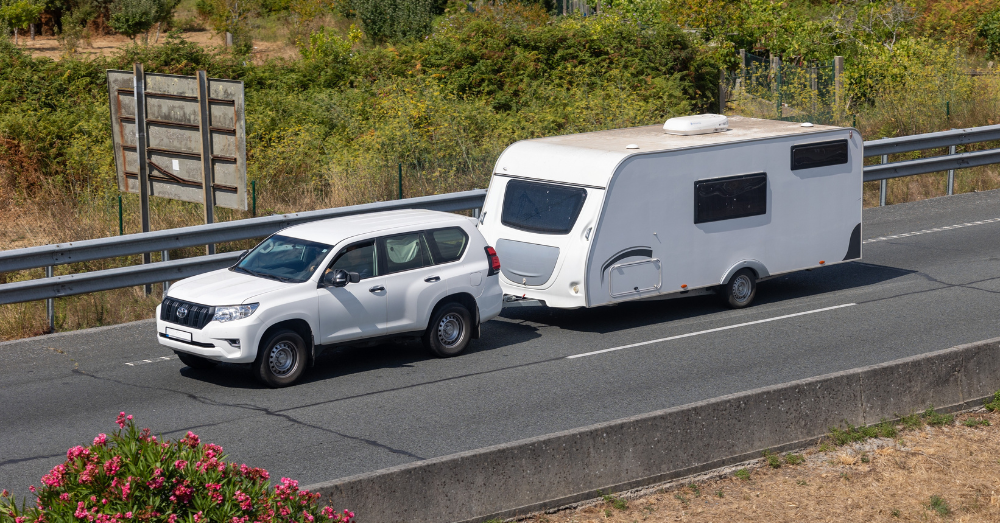
You bought the camper first and figured you’d find a vehicle to pull it later. Smart move. Turns out your Highlander tops out around 5,000 pounds, and that 23-foot travel trailer you just financed weighs 6,800. Time to trade up. Good news: there’s a sweet spot of SUVs that work as daily family haulers Monday through Friday, then turn into serious tow rigs on the weekend. These vehicles pack enough muscle to pull boats, campers, and toy haulers while still fitting in a standard parking space and getting your kids to school on time.
- Jeep’s Wagoneer leads the pack with 10,000 pounds of towing capacity when equipped with the Heavy-Duty Trailer-Tow Package, making it the strongest family SUV you can buy.
- Ford’s refreshed 2025 Expedition pulls up to 9,600 pounds with its twin-turbo V6, and the extended-length Max version still manages 9,000 pounds.
- Midsize options like the Jeep Grand Cherokee (6,200 pounds) and Toyota 4Runner (6,000 pounds with the hybrid powertrain) offer serious capability without the full-size footprint.
When 5,000 Pounds Stops Being Enough
Here’s the thing about towing ratings: they matter more than you think. Most three-row crossovers max out between 3,500 and 5,000 pounds. That’s fine for a couple of jet skis or a small utility trailer. But once you start looking at real campers, the weight jumps fast. A 22-foot travel trailer typically hits 5,500 to 6,500 pounds before you load it with gear. Add in your family’s luggage, camping equipment, and water tanks, and you’re pushing 7,000 pounds or more. This is where family SUV towing capacity really starts to matter.
Body-on-frame construction separates the serious towing SUVs from the pretenders. These vehicles share platforms with pickup trucks, which means they’re built to handle weight. Jeep’s Wagoneer sits on the same bones as the Ram 1500. Chevy’s Tahoe and GMC’s Yukon share the Silverado’s foundation. This construction method distributes trailer weight across the frame instead of stressing the unibody structure that most crossovers use.
Full-Size SUVs That Actually Work for Families
Ford’s 2025 Expedition just got better at both jobs. Base models pull 6,000 pounds with rear-wheel drive, but spring for four-wheel drive and you jump to 9,600 pounds. Ford ditched the base engine completely, so every Expedition now gets either a 400-horsepower or 440-horsepower twin-turbo V6. Extended Max versions give you 42 inches of third-row legroom, which means actual adults can sit back there on long trips.
Chevy and GMC’s trio (Tahoe, Suburban, Yukon) all hit around 8,000 to 8,400 pounds when you check the right boxes. Suburban stretches an extra foot longer than the Tahoe, giving you 144 cubic feet of cargo space with the seats folded. You’ll need the 5.3-liter V8 and the Max Trailering Package to reach the maximum rating, but that same setup gets you an integrated trailer brake controller and a camera system that shows exactly where your hitch sits.
Dodge’s aging Durango deserves mention because it still delivers. A 5.7-liter V8 with all-wheel drive and the Tow N Go package gets you to 8,700 pounds. Yes, it’s been around since 2011 without a major redesign. But it works, the price stays reasonable, and you can still find one with three rows and V8 power when most brands have switched to turbocharged sixes.
Midsize Models That Punch Above Their Weight
Not everyone needs (or wants) to park a 17-foot SUV. Jeep’s Grand Cherokee handles 6,200 pounds with the base V6, and the three-row L version matches that number. Toyota’s 2025 4Runner got a complete makeover and now offers a hybrid i-FORCE MAX powertrain that produces 326 horsepower and 465 pound-feet of torque. That setup pulls 6,000 pounds, which covers most boats and mid-size campers.
Nissan redesigned the 2025 Armada and switched from a V8 to a twin-turbo V6, but towing capacity stayed at 8,500 pounds. Standard equipment includes a seven-pin wiring harness, trailer brake controller, and sway control. Pro-4X trims add off-road capability if you’re pulling toys to remote trails.
Tech That Makes Towing Less Stressful
Modern towing packages include features that didn’t exist five years ago. Multiple camera angles show you the hitch from above, behind, and both sides. Some systems overlay guidelines on the screen to help you line everything up. Instead of dangling aftermarket units under the dash, integrated trailer brake controllers now live inside the vehicle. These systems sync your brakes with the trailer’s electric brakes so everything stops smoothly together.
Trailer sway control uses the stability system to detect when a trailer starts swaying side to side. Your SUV automatically applies individual brakes and adjusts engine power to straighten things out. Tow/haul mode changes how the transmission shifts to reduce wear when you’re pulling heavy loads uphill.
What You’ll Actually Pay
Base prices don’t tell the real story. Jeep’s Wagoneer starts around $66,000, but you’ll need to add the Heavy-Duty Trailer-Tow Package ($1,770) to hit that 10,000-pound capacity. Ford’s Expedition sits at $54,000 before you option up to the higher-output engine and four-wheel drive. Most of these SUVs land between $60,000 and $80,000 when configured for maximum towing.
Fuel economy takes a hit when you’re towing. Expect single-digit MPG numbers when pulling a heavy trailer up mountain passes. Without a trailer, these SUVs typically manage 15-20 MPG in mixed driving. Hybrid versions like the Sequoia do slightly better at 19 city / 22 highway.
Getting The Numbers Right
Start by weighing your trailer (or the one you plan to buy) at a truck scale. Add 1,000 pounds for gear, water, and propane. That’s your target towing capacity. Now add the weight of everyone who’ll be in the SUV, plus luggage. Subtract that from the vehicle’s payload rating to make sure you’re not overloaded.
If you’re pulling 7,000 pounds regularly, you want at least 8,500 pounds of rated capacity. That margin keeps you safe and reduces strain on the powertrain. For occasional towing of lighter loads (5,000 pounds or less), a midsize SUV makes more sense. You’ll get better daily fuel economy and easier parking.
Trailer brake controllers matter more than most people realize. Some packages include them standard, others charge extra. Make sure you get one integrated from the factory instead of adding an aftermarket unit later. It’ll work better with your SUV’s systems and won’t clutter up your dash.
This post may contain affiliate links. Meaning a commission is given should you decide to make a purchase through these links, at no cost to you. All products shown are researched and tested to give an accurate review for you.