
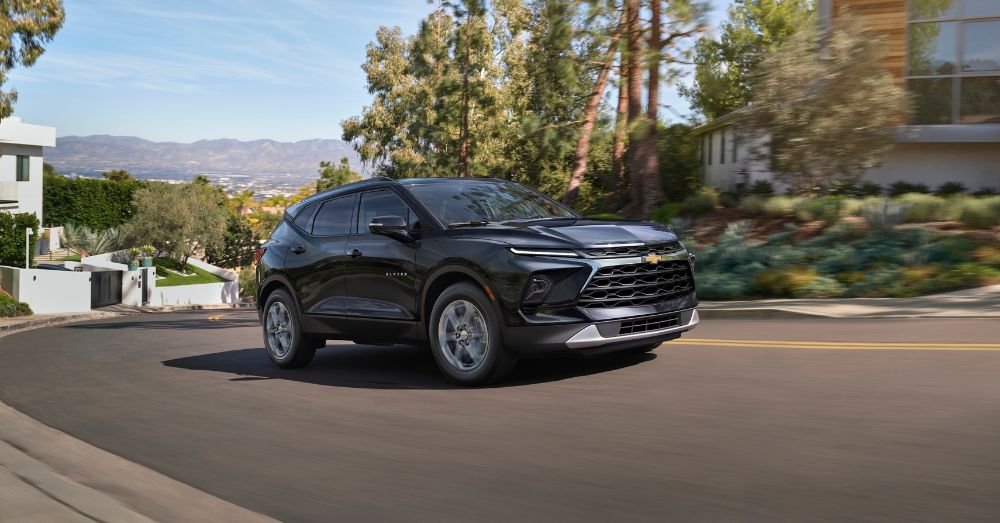
You’ve narrowed down your search to the 2025 Chevrolet Blazer EV and you’re ready to head to the dealership. Smart move. But here’s the thing about test drives: you’ve got maybe 20 minutes with a salesperson riding shotgun, and that’s your one chance to figure out if this electric SUV actually fits your life. Walking in prepared makes all the difference between giving it a quick thumbs up and actually knowing whether you want to drop 50 grand on this thing.
- The Blazer EV’s slow steering ratio requires over 3 turns lock-to-lock, which can feel annoying during tight parking maneuvers and city driving.
- This electric SUV ditches Apple CarPlay and Android Auto completely in favor of Google’s built-in apps, so you’ll want to test whether that works for your daily routine.
- Different powertrain options range from 220 hp in the front-wheel-drive model to a ridiculous 615 hp in the SS trim, so pick your test carefully based on what you actually need.
The Steering Situation Needs Your Attention
Most of the time, the Blazer EV steers just fine. Highways, sweeping curves, gentle on-ramps? No problem. But pay close attention during low-speed stuff. We’re talking about 3.4 turns lock-to-lock here, which is pretty slow by modern standards.
Ask your Chevy dealer to let you do some tight parking lot maneuvers before you hit the open road. Try a three-point turn. Make a sharp 90-degree turn from a stop sign. You’ll find yourself spinning that wheel more than you expect. Some people won’t mind. Others will get annoyed after the third time they’re wrestling with it in a grocery store parking lot.
Google Built-In Apps Replace CarPlay
Here’s where things get interesting. That massive 17.7-inch touchscreen looks impressive, but it won’t run Apple CarPlay or Android Auto. Instead, Chevy went all-in on Google’s built-in system.
During your test drive, actually use it. Punch in a destination on Google Maps. Try connecting your Spotify account. Browse the Google Play store and see what apps are available. If you’re deeply tied to Apple’s ecosystem or you hate the idea of Google having more data about your life, this could be a dealbreaker. On the flip side, some people love not needing to plug in their phone every single time.
Pick the Right Powertrain for Your Needs
The Blazer EV comes in different configurations that drive completely differently. The front-wheel-drive version makes 220 horsepower and 243 pound-feet of torque. That’s adequate but not exciting.
Move up to the all-wheel-drive setup and you get dual motors churning out 300 horses and 355 pound-feet. This one actually feels quick off the line. Then there’s the performance SS that ranges from 365 to 615 horsepower depending on how wild you want to get.
Test the specific drivetrain you’re considering because the difference between them is huge.
Check Those Rear Doors in Tight Spaces
The Blazer EV’s rear doors are longer than you’d expect for a midsize SUV. If you’ve got a narrow garage or you park in tight spots, this matters.
During the test drive, park in a cramped space and try opening those back doors. See if you can actually get in and out without banging into the car next to you. Once you’re back there, the legroom is actually pretty spacious.
Find Some Rough Roads
On smooth pavement, the Blazer EV rides nice and comfortable. But when the road quality drops, things get a little unsettled. Cracked pavement, potholes, rough patches. That’s where you’ll notice the suspension working harder than you’d like.
Don’t just cruise around the nice streets near the dealership. Find some real-world roads. Hit a few bumps. Drive over that sketchy intersection everyone avoids. You need to know if the ride quality will drive you crazy during your daily commute.
What You’re Really Paying For
Pricing starts at $46,095 for the LT trim, jumps to $51,395 for the RS, and climbs to $62,095 for the SS. The 2026 model drops the rear-wheel-drive option but keeps the same pricing for front-wheel and all-wheel-drive versions.
With that many configurations, you’ve got options. But be clear about what you actually need versus what sounds cool on the spec sheet. A base LT will save you over 15 grand compared to the SS.
Your Next Steps
Walking into a dealership prepared changes everything. You’re not just nodding along while someone reads features off a brochure. You’re evaluating whether this electric SUV works for your real life.
Test that steering in tight spots. Play with the Google apps. Drive the powertrain you’re actually considering. Check those door clearances. Find rough pavement. Be honest with yourself about whether the quirks will annoy you every day for the next five years.
The Blazer EV is a solid electric SUV, but it’s not perfect for everyone. Your test drive should tell you which side of that line you fall on.
This post may contain affiliate links. Meaning a commission is given should you decide to make a purchase through these links, at no cost to you. All products shown are researched and tested to give an accurate review for you.